
WireGuard
A free, open-source VPN protocol and set of tools for building encrypted tunnels between devices.
Our verdict
What it does well
- Open source; Linux kernel part is GPLv2, other projects use MIT, BSD, Apache or GPL
- Small design that the project says one person can review in full
- Apps for Windows, macOS, Linux, iOS and Android
Where it falls short
- You set up keys and peers yourself; it is not a hosted VPN service
- The project says it is under heavy development
- No built-in user management or dashboard
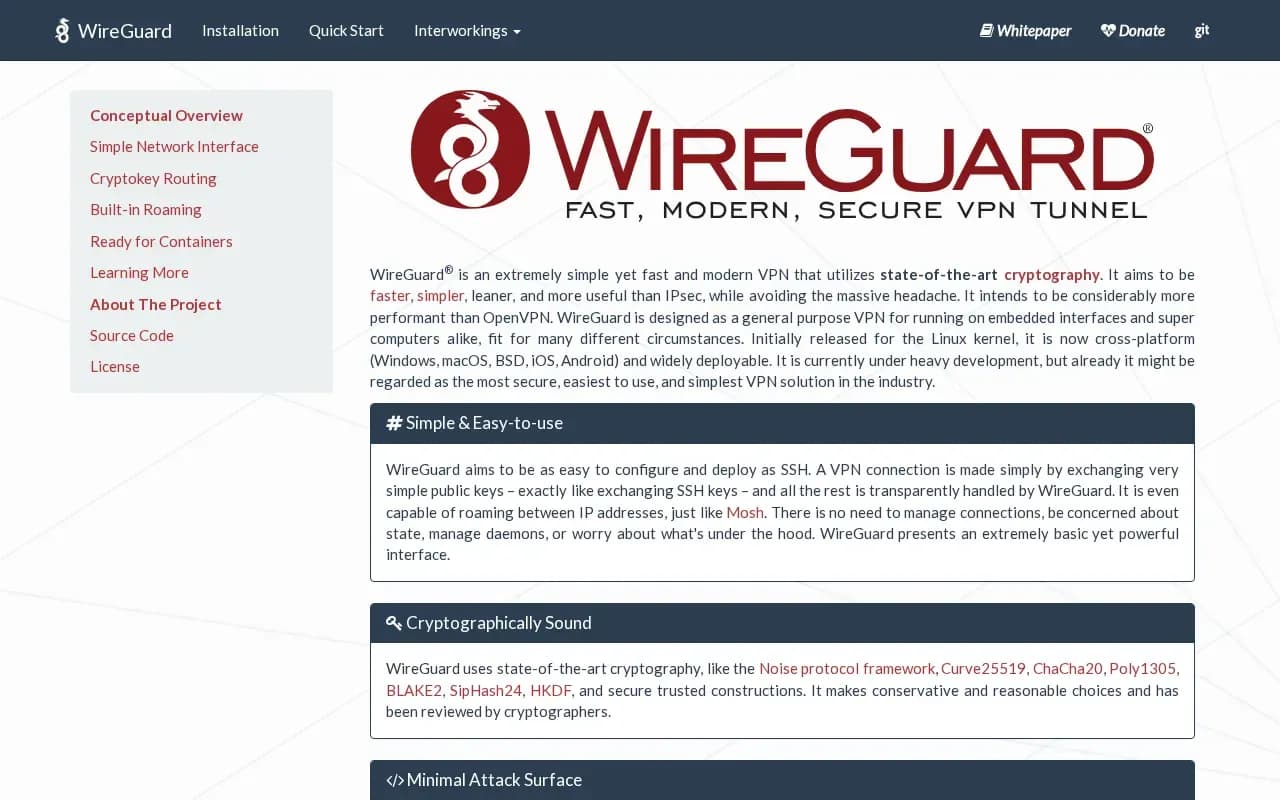
WireGuard is a VPN protocol that carries IP packets over UDP. You configure a network interface with your own private key and your peers' public keys. It started in the Linux kernel and is now available for Windows, macOS, BSD, iOS and Android, according to the project's site.
The WireGuard site says it uses the Noise protocol framework, Curve25519, ChaCha20, Poly1305, BLAKE2, SipHash24 and HKDF, and that it has been reviewed by cryptographers. These are the project's own statements. The site also carries a notice that "WireGuard" is a registered trademark of Jason A. Donenfeld.
WireGuard has no price; the site links to a donations page. Licences vary by component. We checked the official GitHub repos: wireguard-linux is GPL-2.0 with the Linux syscall note, wireguard-tools is GPL-2.0, wireguard-go and wireguard-windows are MIT, and wireguard-android is Apache-2.0.
WireGuard compared
Alternatives to WireGuard

A mesh VPN built on WireGuard that links your devices into a private network with sign-in based access.
- Freemium
- Open source
What users say
Write a reviewNo user reviews yet. If you’ve used WireGuard, share what you used it for and how it went.
Last updated 17 October 2026. Facts checked against the official site on 17 October 2026. How we make money